
Product case study iOS apps 2026
Cine sunt?
Two players. Two identities. One conversation.
A Romanian guessing game for two nearby players, each on their own iPhone or iPad. Give clues for the identity on your screen, listen to discover your own, and commit to one of ten answers.
Visit the app websiteBranding
Warm orange. Clear words. A recognisable pair.
The visual identity connects the paired cards in the app icon with the central idea of two people discovering two identities. Orange actions, cream identity surfaces and rounded system typography carry through the native interface and App Store artwork. The presentation moves from a simple invitation to the actual steps of play.

App Store artwork colors
- Burnt orange
- #C2410C
- Cream
- #FFF0E5
A visible clue
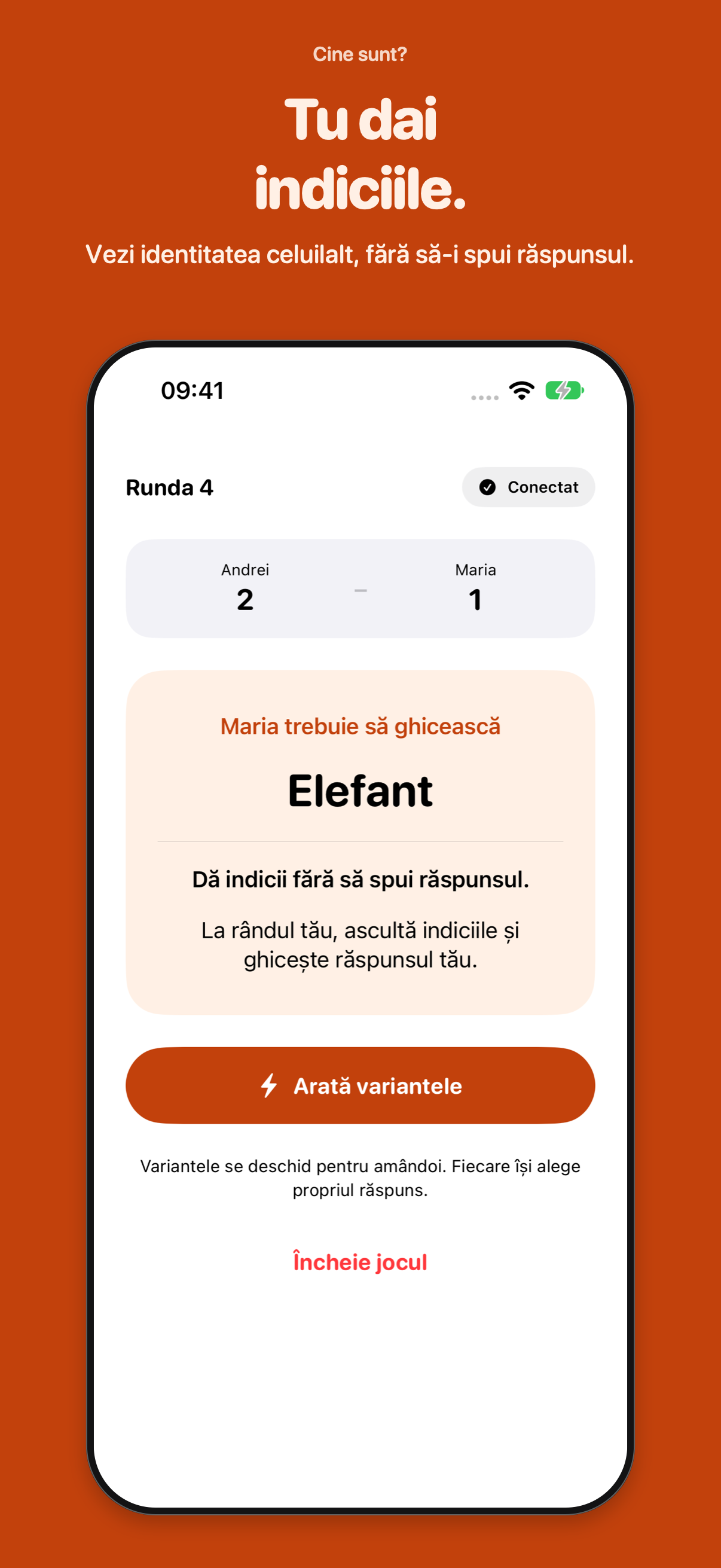
The other player’s name sits above the large identity, making its owner explicit.
One clear action
Creating a game, opening the choices and starting another round each have a prominent control.
An explained result
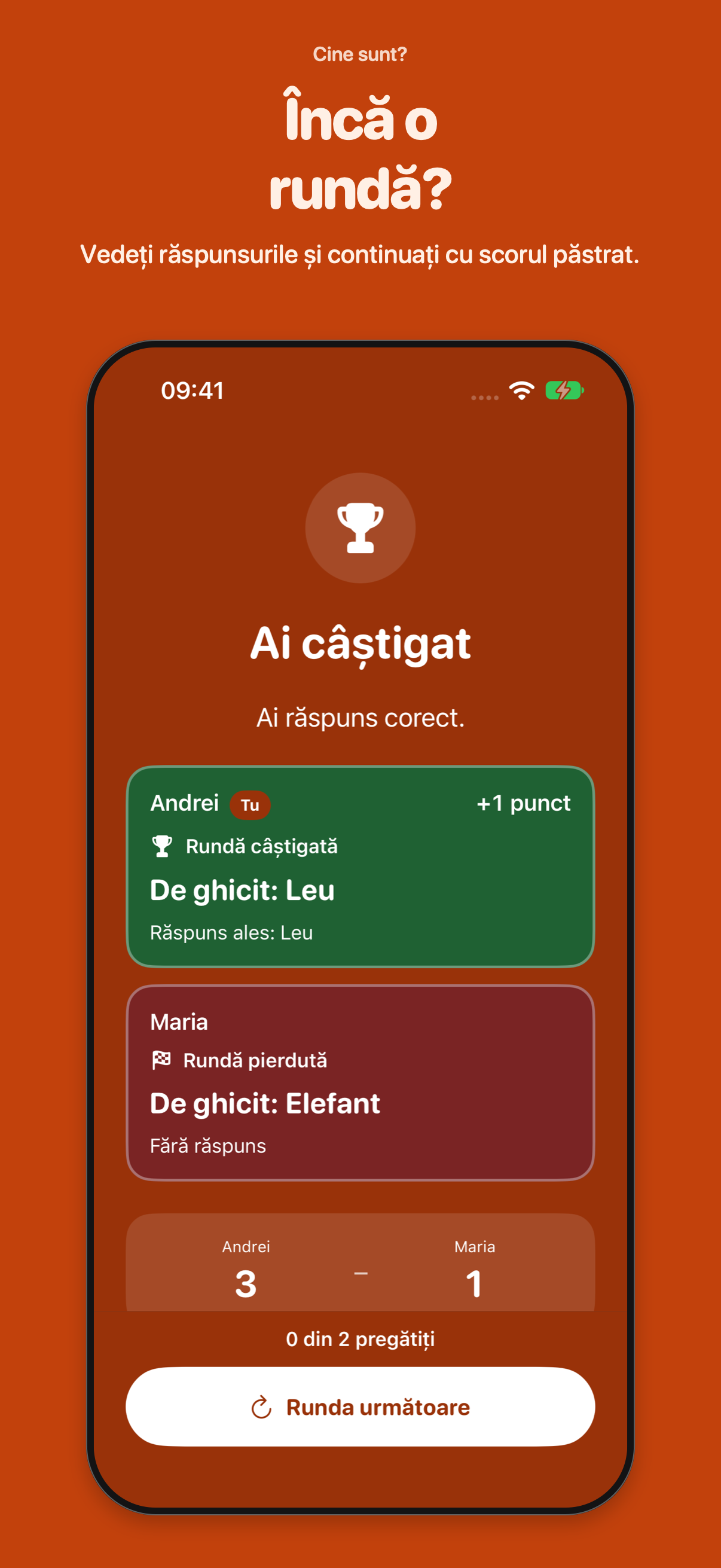
Results combine names, answers, points and written outcomes with colour.
App views
A closer look.
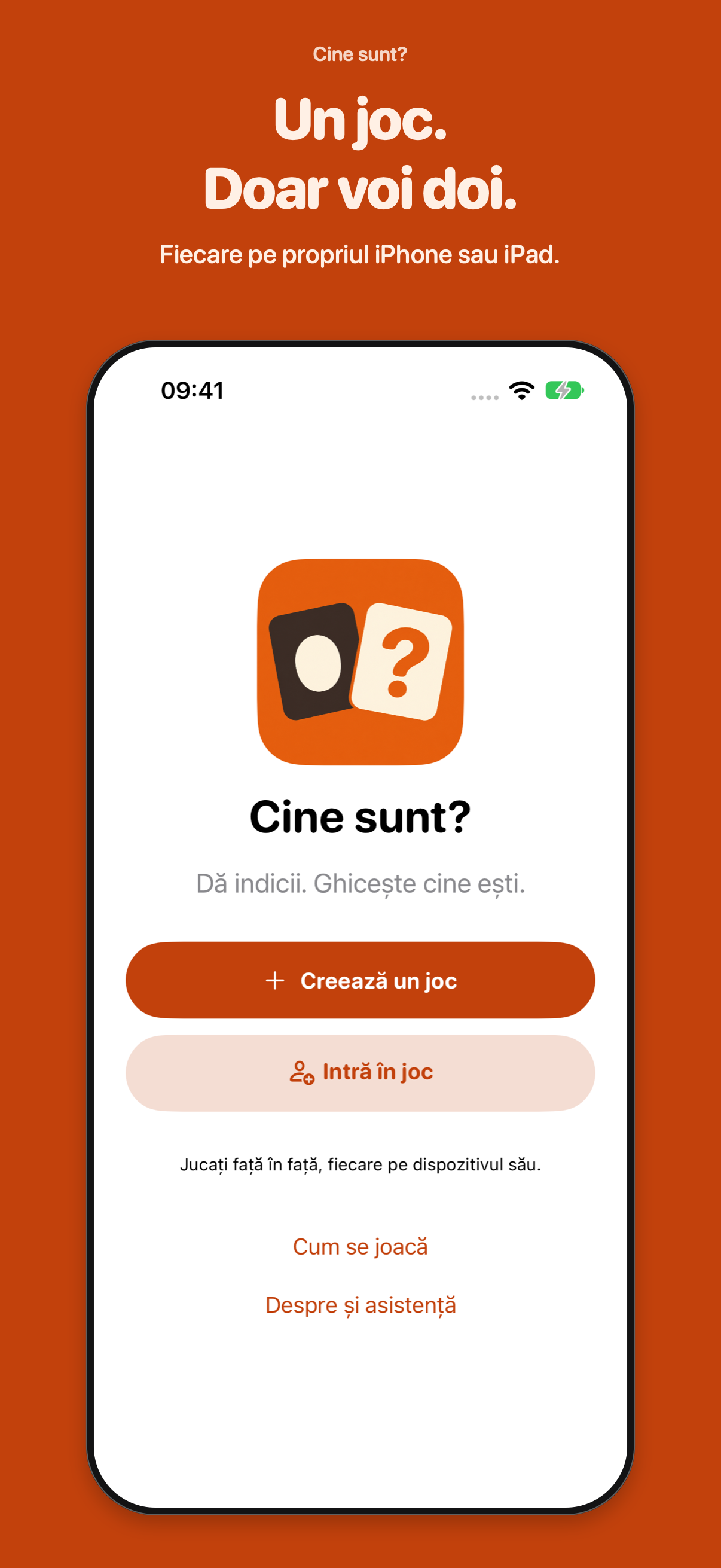
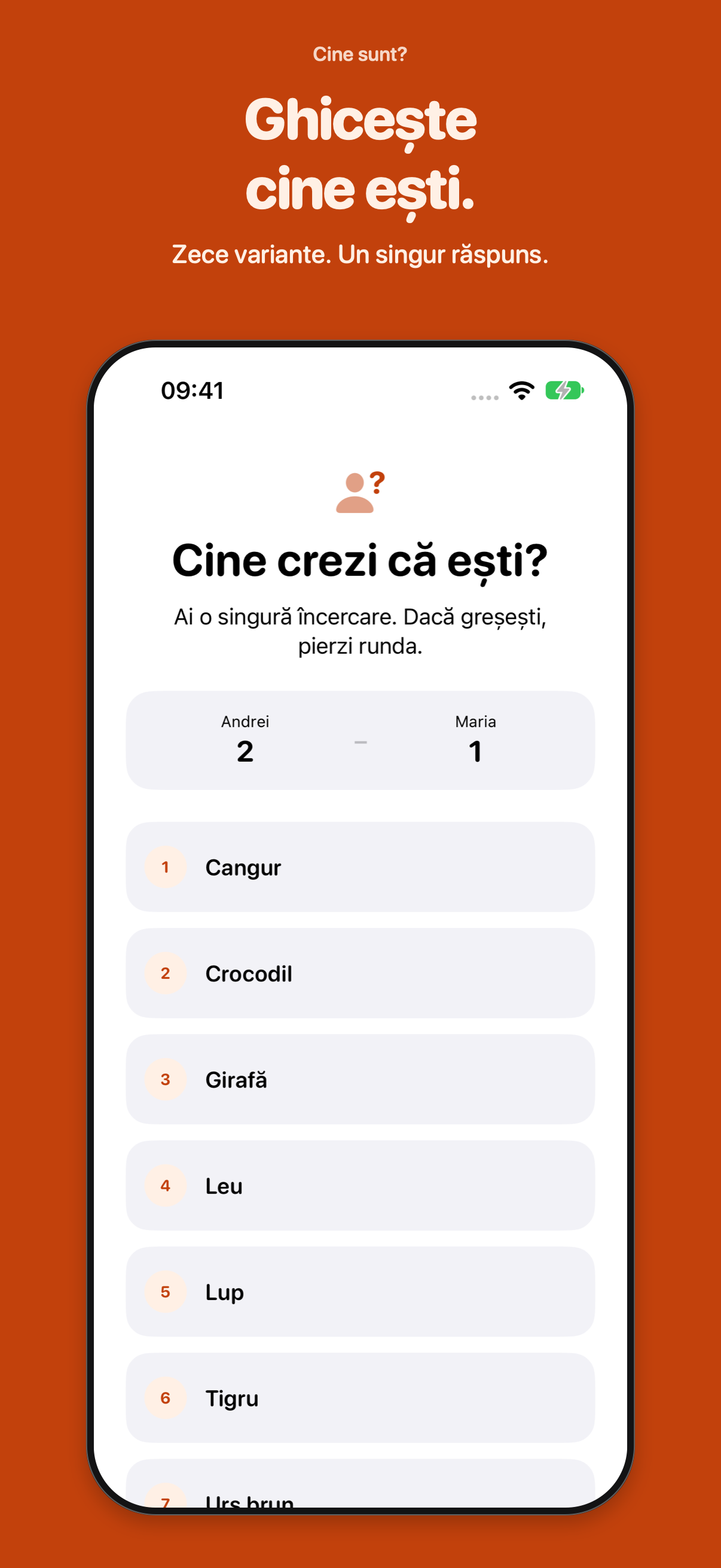
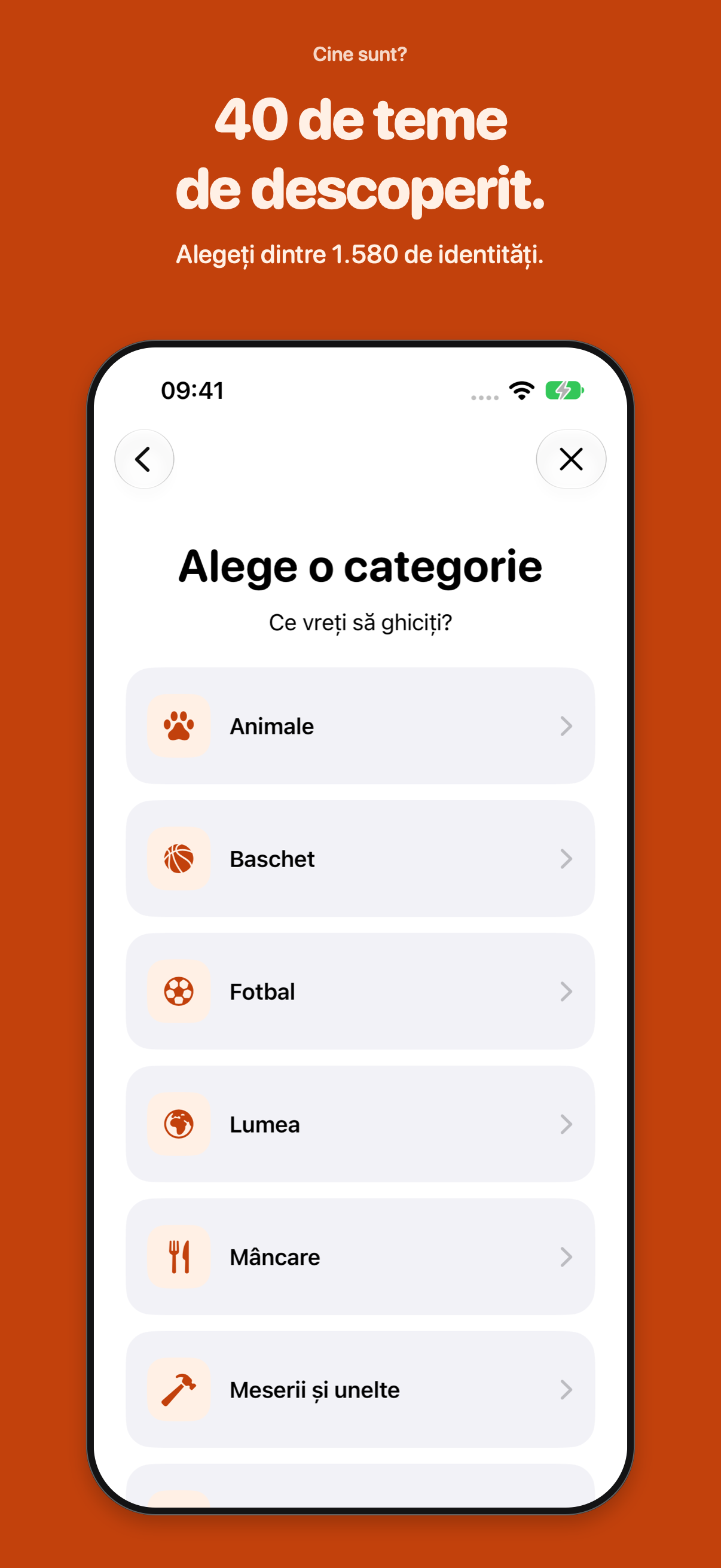
Explore key moments in the game. These App Store images show the Romanian app interface.
Images 1 / 5
Select an image to view the full-size artwork.
The brief
A small game built around the person in front of you.
Cine sunt? gives two people a shared guessing game without turning their conversation into a chat interface. Each device holds a different piece of information: you can see who the other player must guess, while they can see your identity. The clues happen aloud, face to face.
We built the experience around that exchange. The app chooses identities, keeps each answer hidden from its owner, presents the choices and settles the score. Players supply the descriptions and deduction. Animals, food, places, professions, sport and fictional characters offer different starting points for the conversation.
- Players
- Exactly 2
- Content
- 40 themes · 1,580 identities
- Platforms
- iPhone and iPad
- Language
- Romanian
How it works
How a round works.
Play face to face with two compatible devices. Both people give clues and both try to guess.
Create the game and connect
One player chooses “Creează un joc”, enters a name, then selects a category and theme. The other chooses “Intră în joc” and connects to the host. Once both are connected, the host starts the round and plays alongside the guest.
Describe what the other person must guess
Your screen shows the other player’s assigned identity. Give clues without saying the answer. Listen to their clues to work out your own identity, which remains hidden from you. Conversation has no visible countdown; the app does not generate or record your clues.
Open ten choices and commit
Either player can tap “Arată variantele”, opening both answer lists together. Each person receives their own ten choices: one correct identity and nine alternatives from the same theme. Choose and confirm carefully. A submitted answer cannot be changed.
Find out who scored
A wrong answer loses the round immediately and gives the opponent one point. The first correct answer earns a point unless both correct answers reach the host within 0.5 seconds of one another: then each player earns a point. This short draw window measures answer receipt, not the time available for the round.
Keep the conversation going
Results reveal both identities, the submitted choices and running score. Both players tap “Runda următoare” to continue. The host can change the theme between rounds while keeping the score; both confirm readiness again. Starting a new game resets score and identity history.
In detail
Enough variety to change the conversation.
12 categories, 40 playable themes
The bundled Romanian catalogue contains 1,580 identities, from animals and everyday objects to football, music, geography and characters. The theme information sheet shows its description and complete answer list before selection.
Alternatives that belong together
Each answer list draws from curated groups within the chosen theme. The ten names appear in Romanian alphabetical order, with numeric order for numbers. The correct answer is never marked before results.
Variety across a live session
Assigned identities do not repeat within a theme until its remaining pool has fewer than two unused answers. Switching themes preserves each theme’s session history, so returning to a favourite does not immediately start its list again.
The challenge
Keep the conversation simple while the information stays different.
The central constraint reaches beyond hiding a label. Each person must see the other player’s identity while their own stays secret, and the host has to play under those same rules even though its device coordinates the session. Revealing choices and settling the outcome also need to agree across both screens.
The interface therefore needs to explain who an identity belongs to, when an answer becomes final and how to continue together. A catalogue spanning animals, places, people and objects adds another requirement: the alternatives offered in each round must remain within the selected theme.
We developed Cine sunt? as a native Romanian guessing game built around two people and two devices. The work connects a paired-card identity, a focused SwiftUI interface and precise multiplayer rules: each person sees a different secret, both participate, and one shared result keeps the conversation moving.
Give each player only their own view
We separated the complete rules state from the information presented to each player, including the host. The interface names the opponent above the identity card, so the visual explanation follows the same ownership rule as the data.
Build each choice list from a defined catalogue
The engine prepares one correct identity and nine alternatives from curated groups within a theme. Catalogue validation checks membership and uniqueness; the interface orders the choices consistently. Theme previews let players inspect the available content before starting.
Make a close finish an explicit rule
We defined the draw as two correct answers received by the host within 500 milliseconds. Boundary tests distinguish an answer at the deadline from one arriving afterward, giving the result screen a single outcome to explain.
The build
Simple to follow. Precise about the rules.
The native SwiftUI interface sits above a separate rules engine. Although the host coordinates the game, its screen receives the same restricted view of information as the guest: the opponent’s identity and, after reveal, its own unmarked choices. That separation keeps presentation aligned with the guessing rules.
Answer timing uses the host’s monotonic clock. Tests cover correct answers received at 499, 500 and 501 milliseconds, alongside wrong answers, repeated commands and rematches. The catalogue is validated for unique names, valid theme membership and complete candidate sets. Native text scaling, semantic colours and Reduce Motion preferences also shape the interface.
The result
One complete loop, from choosing a theme to playing again.
The implemented app brings together nearby pairing, private identity views, shared choice reveal, confirmed answers, scoring and rematches across 40 Romanian themes. Its paired-card icon and orange-and-cream artwork introduce the same interaction that the native screens explain. The project combines product identity, interface design, catalogue structure and tested game logic in one coherent experience.
Good to know
What you need to play.
Two supported devices nearby
Both devices need iOS or iPadOS 26.6 or later and Wi-Fi Aware compatible hardware. The operating-system version alone does not guarantee support. Use the same game version and keep it open on both devices; gameplay uses their local connection without internet.
Romanian, with the catalogue included
The native interface and game content are Romanian. iPhone play uses portrait orientation; iPad supports portrait and landscape. All themes are bundled with the app, without a content subscription or download step.
Free, with session data kept in memory
There are no accounts, ads or purchases. Player names, answers and scores stay in the participating devices’ session memory and are not sent to an app server or retained for future games. Website visits and support messages have separate privacy information.
A few useful answers.
Can several people play on one phone?
Cine sunt? is designed for exactly two players, each with a compatible device. It has no shared-phone mode, teams or spectators. Both players take part in giving clues and guessing.
Do I need to hold the phone against my forehead?
No. Read the other player’s identity on your own screen and give clues aloud. Your own identity stays hidden until results. Choices and confirmation use on-screen controls, with no tilt gestures.
Does the score survive closing the app?
The running score belongs to the current session. Continuing rounds or changing themes preserves it, but a new game resets it and the session is lost when the app terminates. There is no account history or online leaderboard.