Website redesign and SEO: a practical migration checklist
Plan a website redesign with a clear page inventory, URL mapping, launch checks and monitoring so customers can still find your services after the move.
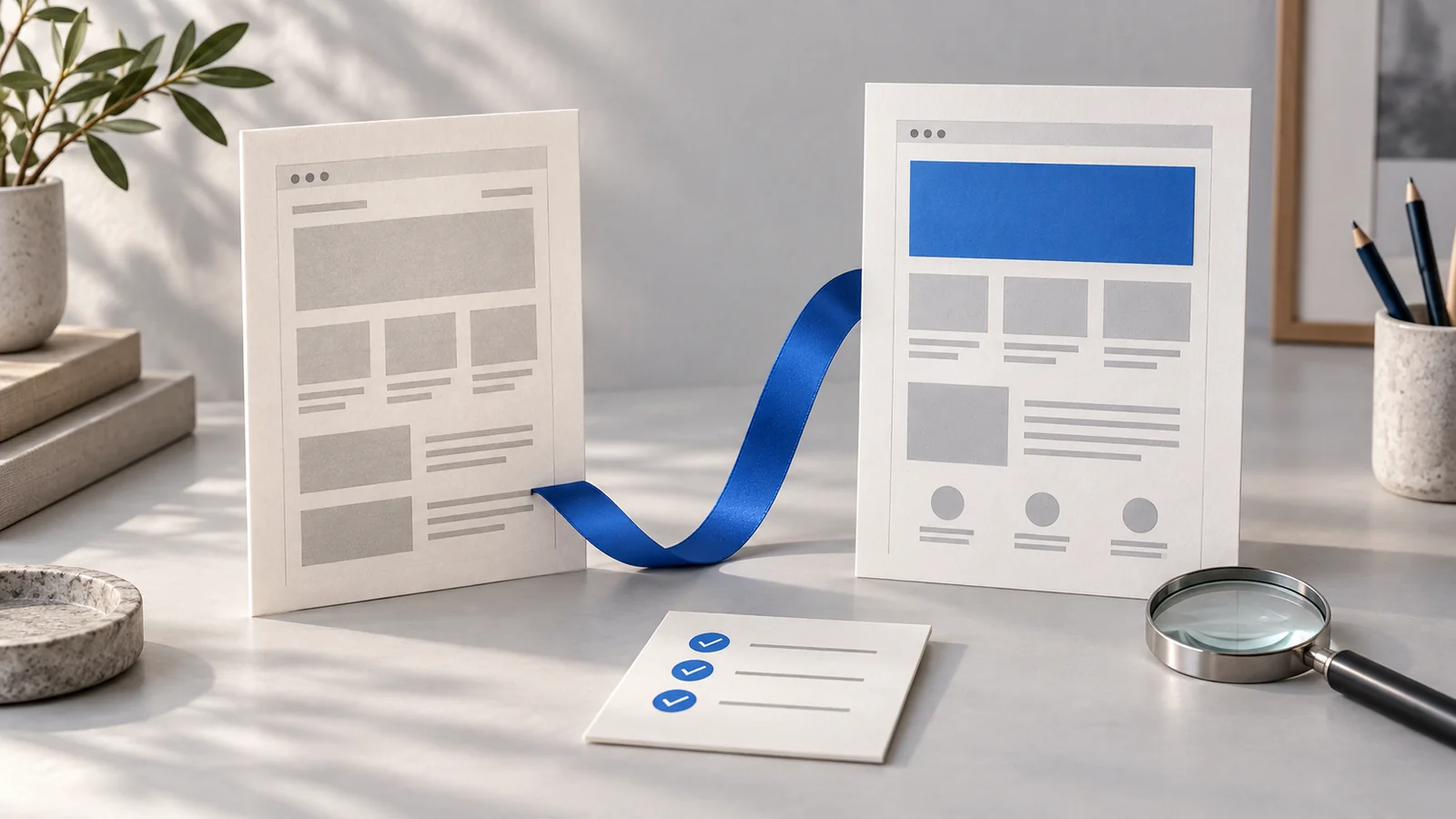
A redesigned website can look better and still make an established customer journey harder. Someone follows an old service link from an email, lands on a generic page and cannot find the information they expected. The new navigation may be polished, but the business has lost the thread of that visit.
For a service business, a redesign should improve presentation while preserving useful routes into the offer. That requires decisions about existing pages, content, addresses and enquiries before launch day. This checklist is a practical handover framework for an owner and the team rebuilding the site. It does not promise unchanged search rankings.
Define what the redesign is supposed to fix
Write a short brief with observable problems. Perhaps mobile visitors struggle to request a quote, the services have changed, or the current content no longer explains whom the business helps. “Make it modern” is a direction for appearance, not a test of whether the project worked.
Choose two or three outcomes that the team can inspect. A visitor should be able to identify the relevant service, understand the next step and send an enquiry without calling to ask how the website works. Agree who will review each outcome and what evidence they need.
Separate essential launch work from experiments. A new brand, a new domain, rewritten offers and a new booking process are different decisions. Put each in the brief with its reason, owner and dependencies. Our article on signs that a website needs a redesign helps establish the starting problem before discussing implementation.
Build a page inventory that reflects the business
Create a working spreadsheet with one row for each existing page. Add its purpose, language, person responsible for its accuracy and proposed treatment. Include campaign pages and documents that the sales team actually sends to prospects, even when they are absent from the main menu.
Ask customer-facing colleagues which links they use repeatedly. A frequently shared installation guide may matter more to the business than a prominent but outdated news page. Record those observations separately from measured traffic so that opinion and evidence remain distinguishable.
A useful review meeting ends with a decision for every page: keep it, improve it, combine it with a clearly relevant page, or retire it. “We will decide after launch” leaves a hidden dependency for whoever implements the new navigation. Give disputed pages an owner and a deadline instead.
Give every changed address a destination
A page map connects each old address to its intended destination. Google's site migration guidance recommends preparing this mapping and avoiding redirects to unrelated destinations. It also advises keeping redirects for at least a year and warns that search visibility may fluctuate during a move.
Consider an illustrative renovation company. Its old kitchen page becomes a more complete kitchen renovation guide. That is a plausible replacement. Sending the same visitor to a broad homepage forces them to repeat the search. Review the destination through the customer's question, not just the new menu structure.
Have the business owner approve the map before the implementation team writes rules. Add a brief explanation for each consolidation. When there is no useful replacement, record that decision explicitly and agree how the retired page will be handled. Keep the approved map with the launch documents rather than leaving it in a private chat.
Ask for the correct redirect behaviour
Google recommends a permanent server-side redirect when a page has permanently moved; HTTP 301 and 308 express that change. Temporary redirects serve a different purpose. See its redirect documentation.
The practical acceptance test should name the old address and the expected final page. Ask the developer to provide the response status and destination, then open the address yourself in a fresh browser session. A page that eventually appears is not enough evidence that the intended rule is in place.
Keep a small set of important journeys for manual review: a link in a sales email, a service link on a business profile, and a saved article. Assign updates to the people who control those channels. This makes the website handover a shared business task instead of an isolated development ticket.
Keep search annotations consistent with the new pages
A canonical URL identifies the preferred version of a page. Google treats canonical links and redirects as strong signals and sitemap inclusion as a weaker one; these should not point to conflicting destinations. Its canonical URL guidance also recommends linking internally to the preferred address and using an appropriate language version.
For a Romanian and English site, ask for a side-by-side review of corresponding service pages. The English description should represent the same offer, and the language switch should lead to the relevant translation. A technically valid link to an unrelated page is still a poor customer experience.
Use a shared content approval sheet for titles, descriptions, service claims and images. If a customer-facing colleague cannot recognise the offer from those fields, resolve the wording before launch. Our bilingual website guide covers the broader content decisions.
Review a real enquiry journey before launch
Set aside a review session on a phone and a desktop. Begin at a service page rather than always starting from the homepage. Read the offer, follow the call to action and complete the agreed test enquiry using synthetic details in a safe test environment.
Check more than the success message. The responsible team member should receive the correct information, understand which service was requested and know what happens next. If the redesign changes form fields, confirm that the sales process can use the new answers. A beautiful form that asks the wrong questions creates manual work later.
Include keyboard navigation, readable labels, error messages and both languages in the review. Also ask whether optional measurement respects the visitor's choices. Use the website lead measurement guide to keep business outcomes separate from superficial click counts.
Give launch day an owner and a recovery plan
Write down who can approve the release, who can correct a broken page and how the business will report urgent problems. Choose a time when those people are available. A launch scheduled around a calendar slot alone can leave a small team without the person needed to resolve a critical issue.
Keep a recoverable copy of the previous site and agree how new enquiries will be protected if a rollback becomes necessary. Ask the technical owner to explain the recovery procedure in plain language. The owner of the business should know whom to contact and what information to provide, even if they never execute the procedure.
Prepare a short launch record: release time, approved page map, completed checks, known limitations and the person accepting each limitation. Distinguish a minor visual adjustment from a blocked contact route. That record gives the follow-up conversation a concrete starting point.
Monitor specific pages and outcomes after the change
Google's traffic-drop guidance distinguishes technical problems, search changes and seasonal demand. It recommends investigating Search Console data rather than assuming that every decline has the same cause.
Set a review rhythm that fits the business, with an early operational check and subsequent weekly reviews. Compare the same services, languages and enquiry types. Note holidays, campaign changes and changes in measurement alongside the release date, so the team does not mistake an unrelated event for a redesign effect.
Give each unexpected result an investigation owner. A missing enquiry and a change in search impressions need different evidence. Start with the affected customer journey, record what you found and decide the next action. Avoid repeatedly rewriting working pages in response to a single quiet day.
A useful redesign handover includes the page inventory, approved address map, content decisions, test evidence and a follow-up owner. If you are planning a rebuild, bring those questions into the project discussion. They make the scope clearer and give both sides a practical way to judge the finished work.