iOS apps · 2026
Shady Guess
A different question. The same uncertainty.
A native party game in which similar answers can hide different questions. Private screens and a staged reveal carry the group from an individual response to a shared discussion.
In preparation for iPhone and iPad.
- Platform
- iPhone and iPad
- Players
- 3–5 free · up to 10 with Plus
- Connection
- Same Wi-Fi network
- Languages
- Romanian, English, German, French and Italian
The brief
Keep everyone guessing. Including the host.
One player receives a different question, but no one is told their role. The interface has to preserve that uncertainty while collecting answers, presenting a shared discussion and opening a private vote. Hosting the game must not expose information that other players cannot see.
Our role
Visual identity, question pairs in five languages, interaction design and native SwiftUI development for a local multiplayer game.
Visual direction
Purple holds the mystery together.
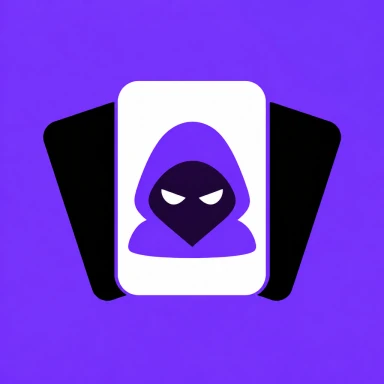
A hooded purple figure on a white card sits in front of two dark cards. The concealed face expresses the uncertainty at the centre of the game, while a clear silhouette keeps the icon recognisable at small sizes.
Purple links the identity to primary actions, selection states and category symbols. Neutral system surfaces give questions and answers visual priority. Rounded system headings soften the dark character artwork and keep the everyday interface familiar.
App Store artwork colors
- Purple
- #7F2DEA
- White
- #FFFFFF
A concealed character
The hood and bright eyes communicate suspicion without needing text.
A purposeful accent
Purple identifies actions and selection; it does not replace the written game state.
Space for language
Neutral surfaces and rounded native headings support names, questions and longer answers.
Interaction design
Private responses. A shared reveal.
The round changes what each person can see, one deliberate stage at a time.
Gather the group
A nearby lobby identifies the host and participants. Category and round options are settled before the first private question.
Collect individual answers
Each player receives one question and confirms a short response. Their role stays hidden, and an accepted answer cannot be changed.
Open the discussion
The group question and attributed answers appear together. Players compare explanations before the host opens voting.
Resolve the uncertainty
Private votes lead to both questions, the impostor and the score. The impostor is caught only with more votes than anyone else; a tie lets them escape.
App views
See the app in use.
App Store screenshots in English. Choose iPhone, iPhone Duo or iPad.
Design in practice
Information boundaries in the game model.
Game rules, local networking and subscription access are separate from the SwiftUI views. The host sends a player-specific view containing only the information available at the current stage.
Accepted answers survive a temporary connection interruption while the session stays active. Waiting and removing a disconnected player are explicit host choices; removal cancels the unfinished round. Gameplay remains in memory, with only language and appearance preferences stored locally.
Pair questions around comparable answers
Different situations invite the same kind of response. A plausible answer can belong to either question, giving the conversation something to examine without identifying the impostor immediately.
Reveal the round in stages
Private question, shared question and answers, vote, then result: each stage has a distinct purpose. Progress indicators show when the group is ready, while the host advances without a countdown.
Give the host a player’s view
The host can also be the impostor. Their screen follows the same information boundaries as every other participant, even though their device coordinates the round.
The result
A clear structure for an uncertain conversation.
The implemented flow connects a local lobby, private responses, face-to-face discussion, voting and a final ranking. The content creates ambiguity; the interface makes progress understandable. The project remains in development and internal testing, with no public launch announced.