Do you still need a website if your business is already on Instagram?
How websites and Instagram serve different roles in discovery, credibility, ownership, search visibility, customer journeys, and conversion.
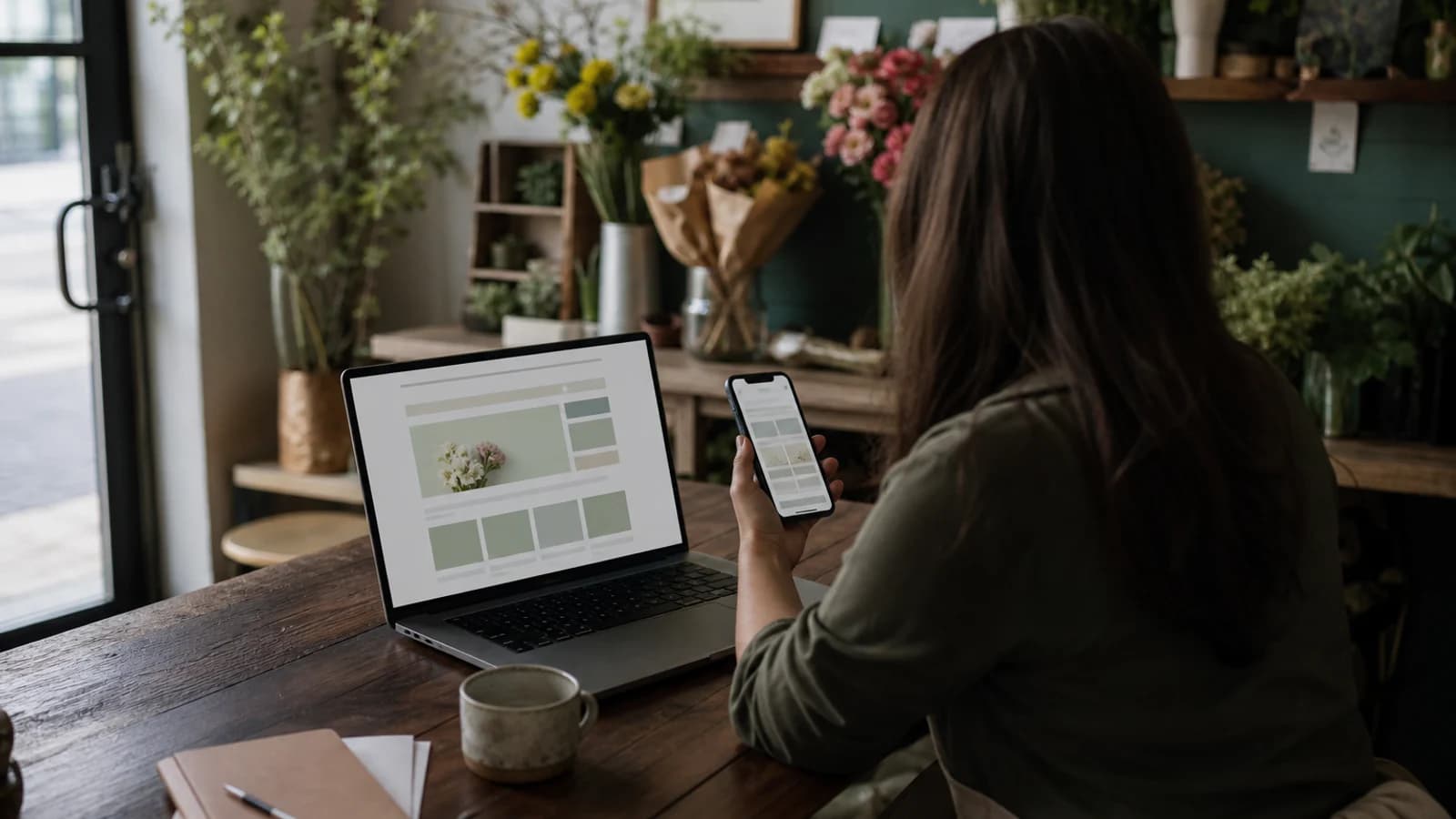
Instagram can be excellent for showing what is happening now. A restaurant can publish tonight’s special, a florist can share a fresh arrangement, and a studio can reveal work in progress. The platform is visual, familiar, and already part of many customers’ daily routine.
That does not make a website obsolete. It means the two channels have different jobs.
Instagram is a communication channel run by an external platform and organised around a feed. A website is a controlled destination built around your customer’s decision. One helps you remain visible and conversational; the other helps a person verify the business, understand the full offer, and act without searching through months of posts.
Social media is strongest at attention
Instagram makes frequent, lightweight publishing easy. Stories, reels, carousels, and messages can keep a local audience connected to the people behind a business. The format is particularly useful for:
- new work and behind-the-scenes moments;
- daily menus, events, arrivals, and limited availability;
- visual proof of atmosphere or craft;
- community conversation;
- informal questions and first contact.
Its weakness is structure. A person who arrives with a specific question may need to inspect the bio, highlights, recent posts, comments, and direct messages. Opening hours may be in one place, prices in another, and the current service list nowhere at all.
A feed is organized by recency and engagement. A buying decision is organized by questions.
A website turns questions into a journey
A useful website can present the essential information in the order a customer needs it:
- What does this business offer?
- Is it appropriate for me?
- Where does it operate?
- What does it cost, or what affects the price?
- What evidence can I inspect?
- How do I book, visit, call, or request an offer?
That sequence is difficult to maintain inside a social profile. On a website, every important service can have a stable address. Search results, advertisements, emails, QR codes, and social posts can link directly to the relevant answer rather than to a general profile.
Ownership matters when the platform changes
You do not control Instagram’s interface, recommendation system, formats, moderation, or account recovery process. A feature can disappear, reach can fall, and an account can be restricted. Even without a crisis, the platform decides which followers see a post.
A website also depends on infrastructure: a domain, hosting, software, and suppliers. The difference is that these parts can be placed in accounts the business owns, documented, backed up, and moved. The company controls the information architecture, analytics choices, conversion paths, and publication priorities.
This is not an argument to abandon social media. It is an argument against making one external account the only address of the business.
Search behavior is broader than Instagram
People do not always start with a brand name. They search for “children’s dentist near me,” “private dining Bucharest,” “architect for house extension,” or “English-speaking physiotherapist.” A well-structured website can create dedicated pages for those services, locations, and questions.
Those pages can appear in search, earn links, be shared directly, and provide source material for AI-assisted discovery. A social profile may appear for the business name, but it offers less control over which information is indexed and how a specific service is explained.
For a local business, the website also works with the Google Business Profile. The profile handles maps, reviews, hours, and local discovery; the website provides the depth that does not fit inside the listing.
Credibility comes from consistency, not mere presence
Having a domain does not automatically make a business trustworthy. A neglected website with old prices and broken forms can damage confidence. The advantage comes from publishing complete, current, consistent information across the website, business listings, and social channels.
Customers often use these surfaces together. They may discover a restaurant in a reel, check reviews in Maps, read the menu on the website, and then reserve. They may find a clinic in search, inspect the team and services on the site, then look at Instagram to understand the atmosphere.
Credibility grows when the name, address, services, tone, photographs, and next steps agree everywhere.
Direct messages are useful, but they do not scale cleanly
Messaging feels easy to the customer, especially for a quick availability question. For the business, it can create an invisible queue spread across personal phones. The same questions are answered repeatedly, important details are buried, and no one knows whether a conversation became a booking.
A website can reduce unnecessary messages by answering standard questions before contact. It can also route different needs correctly: reservations to the booking system, project enquiries to a structured form, urgent calls to the phone, and simple questions to messaging.
The goal is not to eliminate human conversation. It is to use it where a person actually needs help.
Measurement is clearer on a destination you control
Instagram reports reach, views, interactions, and profile activity. These are useful platform signals, but they do not always reveal whether someone understood the offer or became a qualified customer.
On a website, a business can define meaningful events: opening the reservation flow, submitting an enquiry, tapping the phone number, viewing directions, or downloading a menu. Opening or reloading a confirmation page does not by itself prove a new enquiry; measure successful submissions separately. With appropriate privacy choices, those events can show which pages and campaigns support real action.
The two data sets work best together. Social analytics explains attention; website analytics explains progression toward an outcome.
When Instagram alone may be enough
A dedicated website may not be the first priority when:
- the business is a short experiment rather than a durable operation;
- all sales happen through a marketplace that customers already trust;
- the offer changes daily and carries almost no decision complexity;
- the owner cannot yet keep basic information current;
- the available budget must first solve a more urgent operational problem.
Even then, secure the domain name and maintain an accurate Business Profile if eligible. The cost of postponing a website is lower when the basic digital identity remains under your control.
The smallest website that is still useful
A local business does not need fifty pages to complement Instagram. A focused first version can contain:
- a homepage that states the offer and location;
- a service or menu page;
- an about page with real proof;
- a gallery, work, or testimonial page where relevant;
- a contact page with hours, map, and the right action;
- privacy information appropriate to the data collected.
Keep publishing timely stories and visual updates on Instagram. Link them to stable pages when the customer needs detail. On the website, show selected social content only when it adds evidence; do not turn the homepage into a slower copy of the feed.
Instagram helps people notice the business. A website helps them choose it.
The strongest setup is not website versus Instagram. It is a simple system in which social content creates interest, search and maps support discovery, and the website provides the definitive route to an informed action.